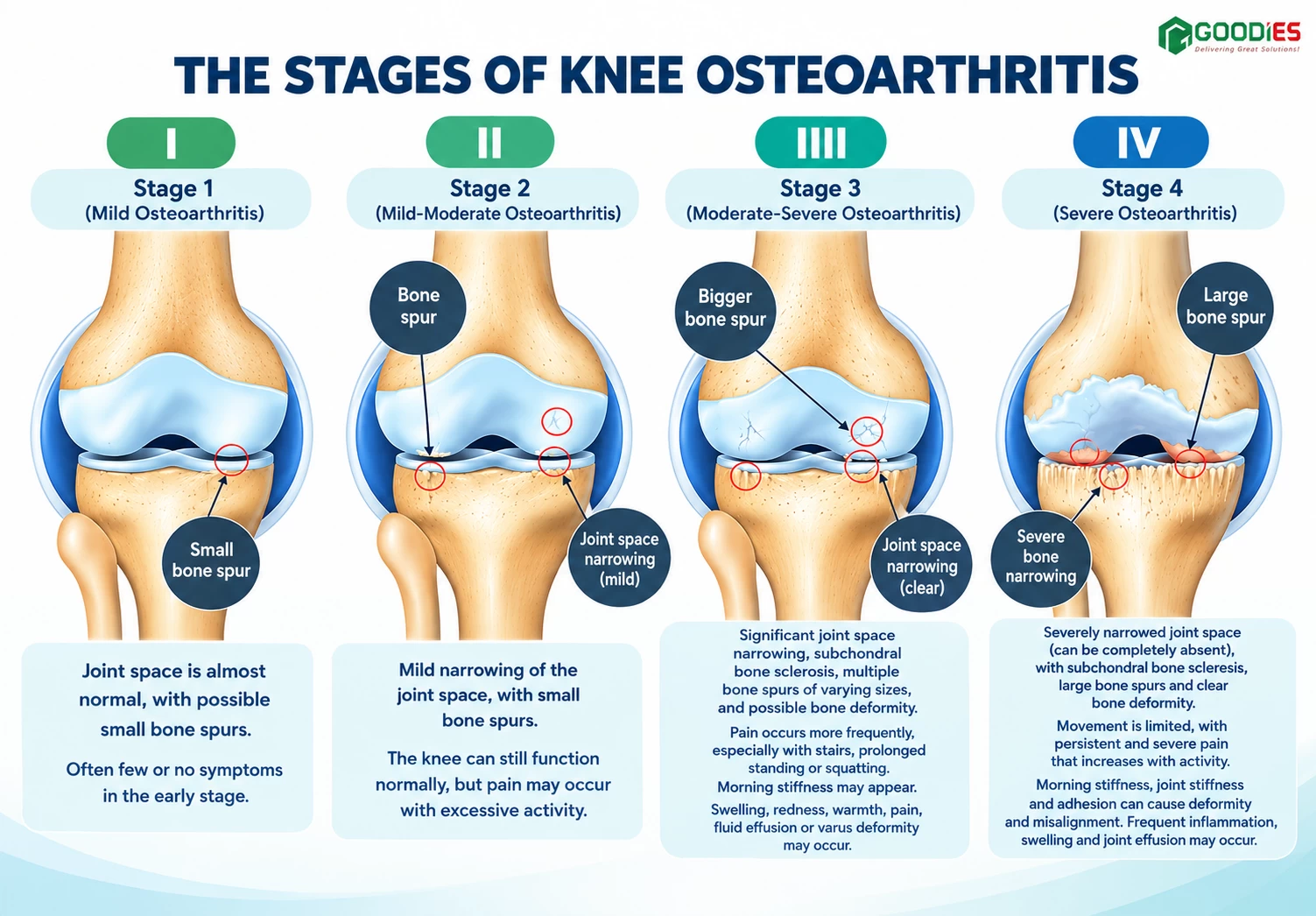
Knee osteoarthritis can progress from mild changes visible on X-rays to severe damage that significantly affects mobility.
Stage 1 – Grade 1 Knee Osteoarthritis
- X-rays show that the joint space is almost normal, with possible small bone spurs.
- At this stage, patients often have no obvious symptoms and can still move normally. However, pain may occur with excessive knee activity, repeated squatting and standing, climbing stairs, or squatting.
- The knee usually shows no swelling, warmth, redness, pain, or deformity.
Stage 2 – Grade 2 Knee Osteoarthritis
- X-rays show mild joint space narrowing and the appearance of small bone spurs.
- The knee can still function normally, but some patients may begin to experience pain and fatigue with prolonged activity or strenuous exercise as bone spurs come into contact with surrounding tissues within the joint.
- Joint stiffness may occur in cold weather or after periods of limited knee movement.
Stage 3 – Grade 3 Knee Osteoarthritis
- X-rays show significant joint space narrowing, subchondral bone sclerosis, multiple bone spurs, and possible deformity of the bone ends.
- The cartilage is severely damaged, affecting joint mobility. Knee pain becomes more frequent, especially when climbing stairs, standing for long periods, or squatting. Pain may even occur during light walking.
- Morning joint stiffness is common. In some cases, the knee may become swollen, warm, red, and painful, with joint effusion or knee deformity.
Stage 4 – Grade 4 Knee Osteoarthritis
- X-rays show severe joint space narrowing, which may be complete, along with subchondral bone sclerosis, large bone spurs, and significant deformity of the bone ends.
- The cartilage is almost completely worn away, exposing the underlying bone. Patients may experience limited mobility, pain during movement, and a grinding or grating sensation as the bone ends come into contact.
- Pain becomes more frequent and severe, worsening with activity. Morning stiffness, joint space narrowing, and joint adhesion may lead to knee deformity and misalignment. Inflammation and knee joint effusion may also occur more frequently.
Recognizing the signs at each stage can help patients better understand the progression of knee osteoarthritis and its impact on mobility.
Learn more on our Facebook Fanpage.